As It Was
There was a specific kind of evening in Ghana that belonged entirely to the Ghanaian movie.
Not the rushed evening, not the evening with somewhere to be. The settled evening — the one where the day’s work is done, the food has been eaten, and the family has arranged itself around the television in the particular formation Ghanaian families adopt when they have collectively decided that tonight they are going to watch a film.
However, the title of the movie changes. Sometimes the actors change, though many of them do not. But the film, the actual film, the one underneath the title is always the same film. The Ghanaian movie is not a genre. It is a formula. And like all great formulas it has been running long enough that the audience does not watch it so much as participate in it.
You already know who is going to betray whom. You already know who is going to be poor in the first act and rich in the third. Also, you already know that the pastor is coming — not yet, not in the middle, but he is coming, arriving exactly when needed and not one minute before. You know all of this before the opening credits finish rolling.
You watch anyway. Every time. Because that is what the evening was for.
The Opening Scene: Every Time, Without Fail
The first five minutes of every Ghana movie following the Ghanaian movie formula, follow a sequence so precise, perhaps it was taught in film school. It was not as an example of good filmmaking but as a masterclass in a formula so deeply embedded in the culture that departing from it would feel like a personal insult to the audience.

It begins with a compound house.
Not just any compound house — a specific kind, filmed in afternoon light that suggests this compound has seen better days and is actively seeing worse ones. A woman is sweeping. She is always sweeping. In many years of Ghanaian cinema no woman in an opening scene has ever finished sweeping. The sweeping is not a task, it is a signal something is about to happen to this woman and it will not be pleasant.
Also within the first three minutes one of two things occurs. Either a black car with tinted windows pulls up — money has arrived and it belongs to someone with bad intentions or a figure appears at the compound gate looking like they have walked a very long way, carrying everything they own in a bag that has seen some good days. This is the poor man. He has arrived. The film has begun and the music confirms what the visuals already told you.
Ghanaian movie music does not suggest mood. It announces it. A slow, sorrowful keyboard melody means suffering is in progress. A dramatic chord, sudden, loud, and slightly out of tune means evil has entered the frame and would like you to know it. Gospel music rising in the background means God is preparing to intervene, though He will wait until the final ten minutes to do so formally.
By the time the title card appears you already know the class of the film you are watching. Poor compound or rich compound. City or village. Witch already established or witch to be revealed. The formula has checked in, unpacked its bags, and settled in for the full ninety minutes. It did not bring anything new.
You already know how this ends. Subscribe anyway.
Subscribe free — no noise, just the satire
The Catalogue: We Have Seen This Film Before
Let us go through them. Not because you need reminding. Because there is a particular pleasure in cataloguing what we already know, in saying out loud the thing that the entire audience has been thinking quietly for several decades.

The Poor Man Who Loves The Rich Man’s Daughter
He sees her first. That is always how it begins. He spots her somewhere — at a market, a bus stop, outside a shop, and the camera lingers on his face long enough to confirm that this man’s life is about to become significantly more complicated than it was this morning.
However, she likes him too. This is established quickly because the film has no time for a slow courtship. There is a witch to introduce and a pastor to save for the ending. They talk, meet again. Something resembling love develops in the space between two scenes.
Then he meets the father.
The father is always the same father. He has money. The tinted windows confirmed this in the opening scene. Also, he has opinions about who his daughter should marry, opinions with a very specific economic qualification attached. The poor man does not meet this qualification. The father makes this clear in terms that leave no room for misinterpretation, sends him away, and the daughter weeps. The mother of the daughter sometimes weeps also, then goes to inform the father where the young man lives so he can be further discouraged.
Additionally, what follows is an extended series of humiliations. He is chased from the house, insulted at the gate, publicly embarrassed at a family gathering he was not invited to and should not have attended, in front of people whose opinions he should not care about but visibly does.
He perseveres, he always perseveres. Because Ghana movies have a deep and abiding faith in the perseverance of the poor man because the script requires him to still be standing in the third act when the money arrives.
And the money always arrives.
The Unemployed Young Man Who Becomes Rich
He is educated. This is important. He has a certificate, possibly two, and has been walking from office to office for longer than any certificate should require a man to walk. The market has looked at his qualifications, smiled politely, and suggested he try again next month.
He lives with his mother — the only person in the film who believes in him unconditionally. She expresses this belief by waking early to cook before he goes out to look for the job that is not yet available. The scene never changes: the mother cooking, the son eating quietly, both understanding that today will probably be like yesterday but neither saying it out loud.
Then one of three things happens. He meets an old classmate who is doing well who knows how good he was in school. He then recommends him to his boss, and the rest becomes history. Or he stumbles upon an opportunity so specific and unlikely it could only have been arranged by the scriptwriter. Then there is the version that has someone hand him money of unclear origin and asks him to do something of unclear legality, and the second act becomes about whether he will compromise his integrity for financial security.
He never compromises his integrity. Ghana movies do not permit the hero to compromise his integrity. He finds another way. The money comes legitimately. By the final scene he is driving a car noticeably better than the one the rich father of his lover drove in the opening. The certificates finally made sense. The market was simply not ready.
The Drunkard Who Knows Everything
Every Ghanaian film has one. Not the hero, not the villain — the man who sits somewhere central to the community, appears to pay no attention to anything, and is in fact paying attention to everything.
He hears the conversation that was supposed to be private and witnesses the meeting with no intended witnesses. He is present, always, at the exact moment when information changes hands that was not supposed to change hands.
And then he tells someone.
Not maliciously. This is the crucial detail that distinguishes the drunkard from the villain. He tells someone because he has had much to drink and the information is simply too interesting to keep to himself, and the person he told it to happened to be standing there when the information became available. He is not a gossip by vocation, he is a gossip by circumstance and mild intoxication.
The information he releases always arrives at exactly the wrong moment and exactly the right one simultaneously. Wrong for the person whose secret it was. Right for the plot, which needed that information to travel from one side of the story to the other.
By the end of the film the drunkard has not changed. He is still sitting in the same place, still drinking, ready to hear the next secret and tell someone about it in whatever film he appears in next. He is the most honest character in Ghanaian cinema. The only one who does exactly what he says, says exactly what he knows, and makes no apology for either.
The Witch Mother-In-Law
She did not want this marriage and made this clear before the wedding. Since the wedding she has been making it clear in ways that range from the passive, forgetting to greet the daughter-in-law, cooking in amounts that accommodate everyone except her to the considerably less passive, which involves a forest, a meeting, some powder, and a specific request that the daughter-in-law’s womb remain unproductive. The most interesting part is when she demands for grandchildren, when she singlehandedly locked them up where she only knows.
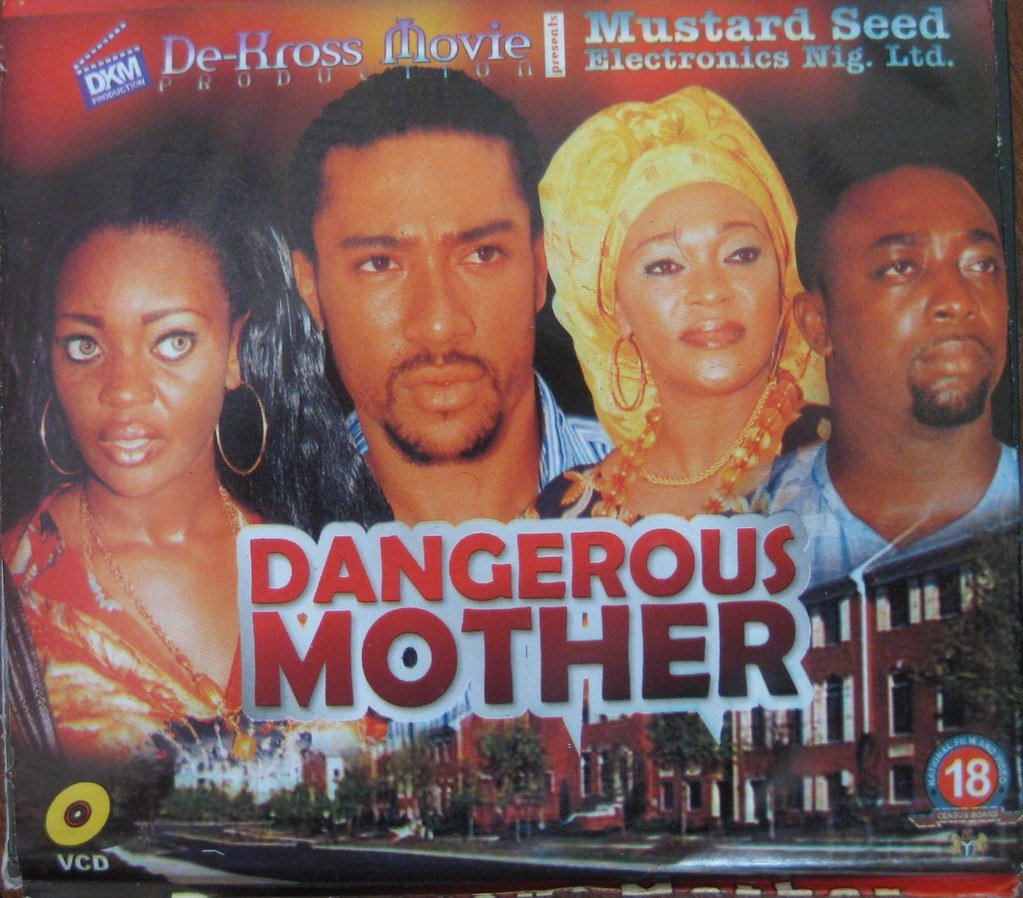
The daughter-in-law knows something is wrong. She has known since the first week. Strange things are happening — small things initially, the kind that could be explained by coincidence if coincidence in Ghanaian cinema were ever the actual explanation for anything. Food that tastes wrong. Sleep that will not come, and even if they come, she is being chased by a shark in the forest. Strange. A persistent feeling of being watched by something not visible in the room.
The husband cannot see it. This is the most consistent and least explicable feature of the Ghana movie witch narrative. The man who lives in the same house as the witch, eats her food, watches her leave at unusual hours, and registers nothing. He is not unintelligent, simply performing the specific blindness the script requires of him so his wife can suffer long enough to make the pastor’s arrival feel earned.
She suffers. The mother-in-law escalates. The red eyes appear, always in close-up, always with the dramatic chord. The daughter-in-law prays, the husband sees nothing, and the audience, which has seen this film before and knows exactly what is happening, watches with the focused attention of people waiting for a specific moment they have been anticipating since the opening scene.
The Friend Who Betrays
He was there from the beginning — present at the humble origins, a witness to the struggle, privy to everything: the certificates, the mother cooking early, the rejections, the perseverance. Introduced early and warmly, the audience might briefly believe this is simply a supportive secondary character providing comic relief and emotional support.
He is not.
At some point in the second act, always the second act, always at the moment things are beginning to look genuinely promising for the hero — the best friend makes a calculation. The hero is about to have something: money, a woman, an opportunity, some combination of all three. The best friend looks at what the hero is about to have and decides he would prefer to have it himself.
What follows is a betrayal only a best friend can execute. He knows where everything is. He knows who to call, which information released to which person at which moment will do the most damage, and he deploys all of it with the precision of someone who has been paying attention not out of friendship but out of preparation.
The hero finds out, sometimes from the drunkard, or from a woman who overheard something she was not supposed to overhear. The confrontation is always the same: two men who were brothers standing on opposite sides of something that cannot be uncrossed, the hero looking physically struck, the betrayer cycling through justifications that satisfy nobody including himself.
By the end of the film the betrayer has received consequences. Ghana movies are very firm on consequences for betrayers. The hero forgives him sometimes. The audience does not.
The City Boy Who Returns To The Village
He left. That is the first thing to understand — he left, and the leaving was the point, and everything that happens in the film is a consequence of the leaving and the returning.
The city changed him, and not corrupted him necessarily. Ghanaian cinema is more nuanced about this than it sometimes gets credit for. His clothes are different now, his speech has acquired something, and he carries himself with the adjustment of a person who has been somewhere and is now back somewhere and is not entirely sure which somewhere he belongs to anymore.
The village has opinions about the return. The elders have opinions. His mother has opinions expressed entirely through the quality of the food she cooks him and the frequency with which she touches his face. His childhood friends carry opinions shaped by genuine affection and a resentment they would not name if asked, but which is present in every interaction.
He has brought something back from the city. Sometimes money, sometimes a woman the village did not approve of because she is also from the city and her clothes communicate this clearly. Sometimes simply an attitude — a way of questioning things not supposed to be questioned, a reluctance to accept structures the village has organised itself around for longer than anyone can remember.
By the end of the film he has learned something. Not that the village was right and the city wrong, or vice versa, Ghanaian cinema is too culturally honest for that verdict. He has learned that he is both and neither, and that this is not a problem to be solved but a condition to be lived. He stays, or he goes back. Either way he is different from the man who left and different from the man who never left, and the film ends with him standing somewhere between those two versions of himself, looking at something the camera does not quite show us.
The Pastor Who Arrives In The Final Ten Minutes
He was always coming. From the moment the witch appeared, from the moment the mother-in-law’s eyes turned red in close-up, from the moment the powder changed hands at the forest meeting, the pastor was always coming. The entire film has been a waiting room for his arrival.
He arrives in the final ten minutes. Not nine. Not eleven. Ten. Ghana movies have an unwritten agreement with their audience about this timeline, honoured across decades of filmmaking without significant deviation.
He is calm, the absolute unshakeable calm of a man who has seen this before and knows how it ends. Carrying a Bible, sometimes a bottle of anointing oil, occasionally a white handkerchief, he enters the space where the spiritual affliction has been operating and begins to pray with the focused intensity of someone not asking God for assistance so much as informing the situation that God has arrived and the situation should begin making arrangements to depart.
The witch resists. There is always resistance — a dramatic chord, some physical manifestation of the spiritual battle, the red eyes appearing one final time. The pastor continues, undisturbed, having factored the resistance into his timeline.
The witch is defeated. The daughter-in-law heals. The husband finally sees what has been happening in his own house for the entire film and reacts with an astonishment the audience, which saw it in the opening scene, finds charming if not entirely credible. The family is restored, the couple embraces, and the pastor stands slightly to one side looking satisfied in the particular way of a man who arrived exactly when he said he would and delivered exactly what he promised. Next scene, the wife has a child, mother-in-law, dead in the previous scene.
The gospel music rises.
The film ends.
You already knew it would end this way, you watched until the end anyway, and you will watch the next one.
Because that is what the evening was for.
How It Always Ends
You have now met the cast. The poor man, the unemployed graduate, the drunkard, the witch mother-in-law, the betraying friend, the returning city boy, the arriving pastor. Seven different characters. Seven different films with seven different titles and seven different posters at the video shop with seven different taglines written in a font that has not been updated since 1960.
One formula.
Here is the thing about Ghana movies that several decades of repetition has obscured, the formula is not a loose set of tendencies or a rough structural guide. It is a precise and undeviating architecture applied to every Ghanaian film produced in every decade, with the consistency of a construction crew handed one blueprint and never given another. The blueprint does not change. The buildings look slightly different from the outside. Walk inside any of them and you are in the same building.
It works like this.
Act One — The Establishing of Suffering
Someone is suffering at the beginning. This is non-negotiable. Ghanaian cinema does not begin from comfort. It opens on a man or a woman who has very little and is in the process of having less — not the psychological suffering of a person who appears to have everything and feels nothing, but material suffering. The compound that needs repainting. The school fees that cannot be paid. The certificate that nobody wants. The daughter-in-law who cannot eat from the same pot as mother-in-law without consequences.
By the end of Act One you know three things. You know who is suffering. You know who is causing the suffering. And you know, because Ghana movies have trained you over decades to know, that the suffering is not permanent. Act One suffering exists specifically to be resolved by Act Three. You are not watching a tragedy. You are watching a formula and the formula has never once ended in Act One.
Act Two — The Escalation
Act Two is where the formula earns its runtime.
Everything gets worse. The rich family humiliates the poor man more thoroughly. The unemployed graduate’s mother gets sick. Act Two is where the mother gets sick, adding a medical dimension to the financial one and ensuring the audience’s sympathy, already fully deployed, is stretched even further. The witch escalates from passive obstruction to active spiritual warfare. The best friend, calculating quietly since Act One, executes his betrayal.
Act Two is a compressed catalogue of everything that can go wrong for one human being in a limited timeframe. Relentless. Specific. Entirely without mercy, not because Ghanaian filmmakers are cruel but because the formula requires maximum suffering before maximum resolution, and the suffering must be proportionate to what is coming.
There is also always a scene where the suffering person nearly gives up. They sit somewhere — a doorstep, a roadside, occasionally an empty church, and have a moment of genuine despair. The music goes quiet. The camera holds on their face long enough for the audience to feel the weight of everything since the opening scene. They almost give up.
But they do not give up.
Because this is Act Two and the pastor has not yet arrived.
Act Three — The Restoration
Act Three in the Ghanaian movie is not a resolution. It is a restoration. This distinction explains everything about what the formula is actually saying underneath the entertainment.
Resolution means the problem is solved. Restoration means everything is returned to how it should have been — not just solved but vindicated, not just fixed but repaid with interest. Ghana movies do not believe in quiet resolutions. They believe in public, visible, undeniable restoration that everyone who caused the suffering is present to witness.
The poor man does not simply marry the rich man’s daughter. He marries her, becomes richer than the father, and the father stands in a scene specifically constructed for him to acknowledge what he said and did in Acts One and Two and what it looks like in light of Act Three. The father sometimes apologises. He always witnesses. The witnessing is not optional.
The unemployed graduate does not simply find a job. He finds success of a scale that makes every office that rejected him look, in retrospect, like they rejected their own fortune. His mother recovers. The certificate finally makes sense. The car in the final scene is always better than every car that appeared in Acts One and Two combined.
The witch mother-in-law is not simply stopped, the pastor exposes her, publicly, specifically, with the whole community assembled to witness, then defeats her with the calm efficiency of a man completing a familiar task. She eventually dies before her grandchild is born.
The betraying friend receives consequences calibrated precisely to the scale of the betrayal. Not violence — Ghanaian cinema rarely endorses violence as the mechanism of consequence. But loss. Public loss. What he betrayed his friend to obtain does not stay obtained. It leaves him in a manner proportionate to how he acquired it, and he stands at the end with nothing that belonged to him and the full awareness of what he exchanged to arrive at that nothing.
The triumphant music rises.
The camera pulls back.
The family is restored.
The evening is complete.
What The Formula Is Actually Saying
Here is the thing about Ghanaian movie formula that years of repetition has obscured. The formula is not lazy. Or rather it is lazy in its execution but not in its belief.
Underneath every formulaic compound house and every dramatic chord and every pastor arriving in the final ten minutes is a very specific and deeply held set of convictions about how the world should work. That suffering is not the final word. That patience and integrity are eventually rewarded even when the evidence is not immediately available. That the people who cause suffering will witness the restoration of the people they caused it to. That God is coming and will arrive with anointing oil and a white handkerchief and will not be late.
These are not small beliefs — these are the beliefs of a people who have had significant reasons not to hold them and have held them anyway.
The problem was never the belief. The belief is honest and Ghanaian and deserves to be on screen. The problem was that the formula became a substitute for storytelling rather than a container for it. The industry handed the blueprint from film to film without anyone stopping to ask what new thing could be built inside it.
The formula said the same thing in the same way for many years.
And the audience which believed the same things the formula believed, which shared every conviction underneath the dramatic chords and the witch’s red eyes eventually needed the thing to be said differently.
Not because the truth changed.
Because truth told in exactly the same way for long enough stops feeling like truth and starts feeling like habit.
What The New Generation Wanted

The generation that grew up on these films grew up and made a list. Not a written list — a felt one. An accumulation of small disappointments that built quietly over years of settled evenings into something that eventually had a name: we have seen this film before.
They did not want the formula abolished. This is the misunderstanding the Ghanaian film industry made and has not fully corrected. The generation was not asking for foreign cinema, not asking for Hollywood structure or Nollywood budgets or Korean pacing or any other import that would require Ghana movies formula to stop being Ghanaian. It was asking for something far simpler and far more demanding simultaneously.
It was asking to be surprised. Even the Indians are doing that in Twi around the evening times we used to watch our Ghanaian movies.
They wanted characters who felt like people rather than positions. Not the suffering daughter-in-law but a specific woman with a specific history and specific reasons for staying in a situation a less specific woman might have left. Not the poor man but a particular man whose poverty has a texture, the specific mathematics of his daily calculations, the specific way he holds himself in rooms where his poverty is visible, the specific combination of pride and shame nobody in the formula had ever stopped to examine because the formula did not require examination. It required perseverance and then restoration and then choir music.
They wanted the compound house to contain more than suffering. The compound house is one of the great settings in African storytelling — a space of genuine complexity, of multiple lives in close proximity, of love and tension and history and negotiation happening simultaneously within the same walls. Ghanaian cinema found the compound house and used it as a backdrop for the witch. The generation wanted it used as what it actually is — a world.
They wanted Ghanaian love stories that did not require a spiritual affliction to generate conflict. As if two Ghanaian people attempting to build a life together in the 21st century do not have sufficient conflict available without anyone flying on a broom. The economy alone could sustain three seasons of dramatic tension without a single dramatic chord.
They wanted the pastor to arrive earlier. Not in the final ten minutes, in the first act, as a full human being with his own contradictions and history, rather than a resolution mechanism the plot deploys when it has exhausted its other options.
They wanted to see themselves, not the versions the formula required but the actual versions.
They waited for that film, they waited through many settled evenings. Also, they kept watching because the evening was still the evening and the family was still assembled and hope is a stubborn thing.
Then Nollywood arrived in their phones, then YouTube channels run by young Ghanaian filmmakers working on nothing budgets but asking genuine questions. Then Showmax and Netflix and a global catalogue of storytelling with no interest in the dramatic chord, no requirement for Act Three restoration, no pastor on standby. The generation did not abandon Ghanaian cinema in a moment of betrayal. They drifted away the way people drift from anything that has stopped speaking to them — gradually, quietly, without announcement, still loving what it once was while being honest about what it had become.
The industry noticed the empty seats. It responded by putting another witch on a broom.
We Have Seen This Film Before
Let me say what needs to be said about Ghanaian movies formula before I say what else needs to be said.
They told our stories when nobody else was telling them. In an industry dominated by foreign voices and foreign faces, here were Ghanaian people in Ghanaian compounds speaking Ghanaian languages navigating Ghanaian problems on a screen. Our fears, our superstitions, our family structures, our spiritual convictions, our specific and irreducible way of being in the world were put on screen with shoestring budgets and confidence that said our lives are worth depicting. The formula, for all its repetition, was built from something genuinely Ghanaian and that genuineness was always its greatest asset.
The formula was not the problem.
Forgetting that the formula was a container and not the content — that was the problem.
The compound house is still there. The family tensions are still there. The spirituality, the class anxiety, the city and the village, the love that crosses the boundaries families build — all of it still Ghanaian, still worth putting on screen. None of it needed to disappear. It needed to grow. It needed a writer somewhere to look at the blueprint and ask what new thing could be built inside it rather than what familiar thing could be reproduced one more time.
That writer exists. Several of them exist. Working right now on phones and laptops and cameras that cost less than the catering budget of a single Kumawood production day. They are making short films and web series and YouTube content that the generation which left the settled evening is watching on the same phones it used to leave. They are telling Ghanaian stories without the dramatic chord and without the predetermined restoration and without the pastor on a ten-minute timer, and the audience that had stopped watching is paying attention again.
Ghanaian cinema is not dead. The formula is dying. These are not the same thing and the industry would benefit enormously from understanding the difference.
The formula knows its lines. It has always known its lines.
But the family has rearranged itself. The settled evening is still the settled evening, the television is still on, and the groundnuts are still within reach.
The audience is simply watching something else now.
And somewhere in a compound house in Kumasi, someone is holding a remote control, scrolling past fifty prophets and thirty-nine mallams, looking for something worth watching.
He cannot find anything either just like many others living in our beloved country.
The Brewed Satire
Disclaimer: Exaggerated for a satiric effect
Share via
Tags
Get every Brewed Satire free in your inbox → Subscribe on Substack